SEO Marketing: Driving Traffic to Your Website
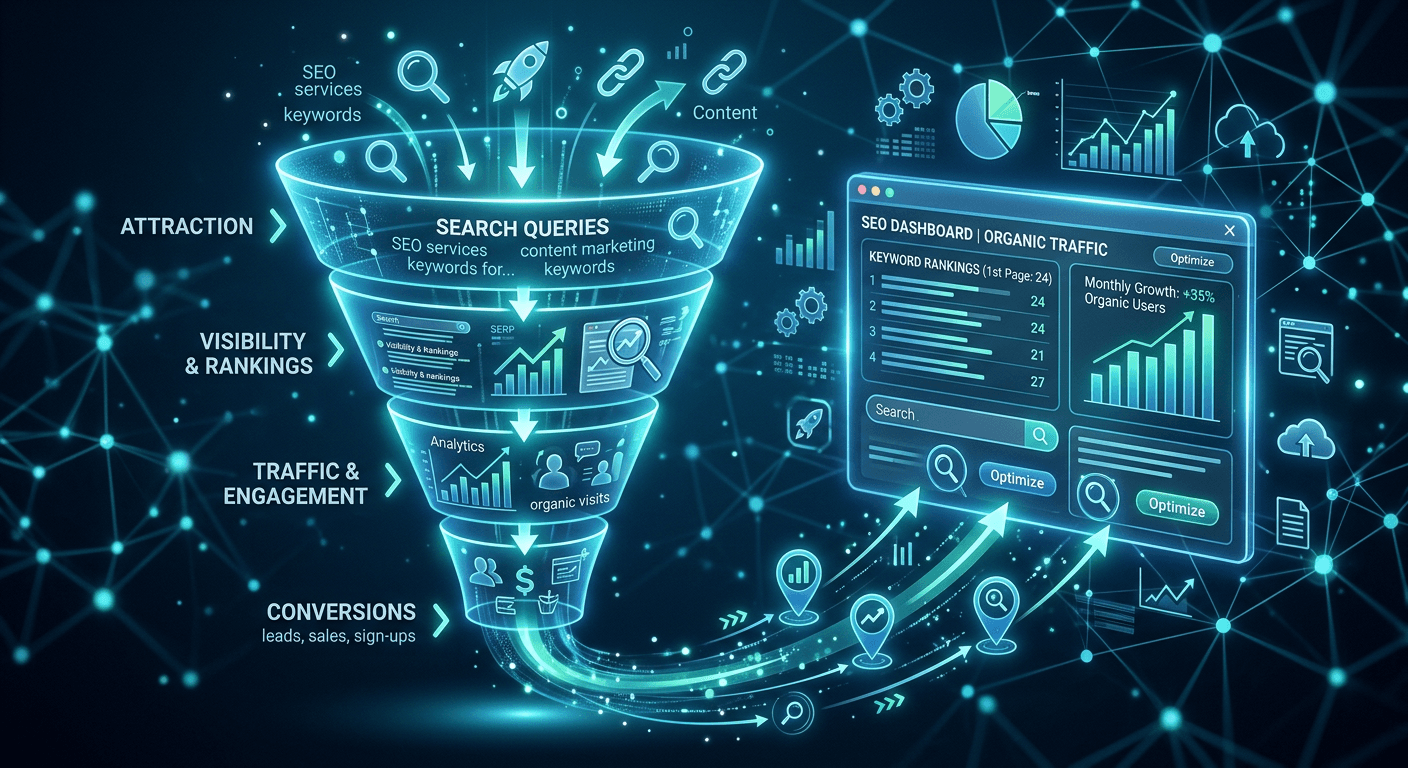
SEO marketing is the foundational strategy for establishing digital visibility, relying on a systematic process of optimizing web pages to earn higher rankings in search engine results. By aligning content quality, technical site health, and authority-building signals with search engine algorithms, businesses can transform their online presence into a sustainable, long-term acquisition channel.
Quick Summary
SEO marketing is the process of optimizing websites to improve visibility in organic search results, driving relevant, high-intent traffic without the need for paid advertising. It combines technical infrastructure, content relevance, and external authority to ensure search engines can crawl, index, and rank content effectively.
- Increases organic brand awareness and credibility.
- Lowers long-term customer acquisition costs compared to paid ads.
- Improves user experience by structuring information logically.
- Provides data-driven insights into customer intent and search behavior.
Table of Contents
- Quick Summary
- The Pillars of SEO Marketing
- Technical SEO and Website Performance
- Content Strategy and Search Intent
- Leveraging SEO Marketing Tools
- Analyzing Google SEO Marketing Trends
- Building Authority and Backlinks
- Frequently Asked Questions
- Recommended Reads

The Pillars of SEO Marketing
Successful seo marketing is built upon three core pillars: technical optimization, on-page content, and off-page authority. Understanding these pillars is essential for any professional navigating the complexities of web marketing and seo because they represent the signals search engines evaluate to determine the relevance of a webpage to a specific query. Neglecting one pillar often creates a bottleneck, preventing even the most high-quality content from achieving its full search potential.
The first pillar, technical seo, concerns the architecture and performance of your domain. This includes aspects like site speed, mobile responsiveness, and crawlability. Without a solid technical foundation, search bots may struggle to index your pages correctly, meaning your content remains invisible to searchers. You can explore our privacy documentation to understand how we secure data that contributes to a more trustworthy user experience.
On-page and off-page efforts act as the content and reputation drivers, respectively. On-page elements involve the tactical use of keywords, internal linking structures, and metadata that help search engines understand the context of your pages. Off-page signals, primarily driven by high-quality backlinks, serve as "votes of confidence" from other reputable sites. Together, these pillars create a cohesive strategy that signals to search engines that your site is a reliable, high-quality resource.
Technical SEO and Website Performance
Technical infrastructure is the silent backbone of modern search engine optimization. Even the most compelling content will struggle to rank if the underlying website architecture is flawed. Google’s algorithms prioritize sites that offer a seamless, secure, and fast browsing experience. When evaluating a site’s technical health, specialists look at page speed metrics, the presence of an SSL certificate, and a logical URL structure that mimics the hierarchy of your content.
Mobile-first indexing is perhaps the most significant development in recent years. Because the majority of global web traffic originates from mobile devices, Google evaluates your site primarily on its mobile version. This means your design must be responsive, font sizes must be readable without zooming, and interactive elements must be spaced appropriately to prevent accidental clicks. Failing to prioritize mobile performance can lead to a significant drop in rankings, regardless of the quality of your content.
Additionally, crawl efficiency is vital. Search engines use bots to discover and interpret your site content; therefore, your terms of service pages and similar site structures should be easy for bots to navigate. By utilizing a clean robots.txt file and an updated XML sitemap, you provide a roadmap for search engines. This reduces the time bots spend on your site and ensures they index the most important, high-value pages first.
Content Strategy and Search Intent
Content is the primary vehicle for seo and marketing success. However, producing content for the sake of volume is counterproductive; the modern algorithm demands that content maps directly to user intent. Search intent is categorized into four main types: informational, navigational, commercial, and transactional. By aligning your content strategy with these specific intent categories, you ensure that your website satisfies the exact needs of the user.
Pro Tip: When drafting content, perform a search for your target keyword to see what is currently ranking. If the top results are listicles, a dense white paper might not satisfy the user's intent. Mirroring the format of the top-ranking content while adding unique value is a proven way to increase rank probability.
Creating high-quality content involves more than just keyword placement. It requires depth, accuracy, and expertise. Search engines now utilize E-E-A-T (Experience, Expertise, Authoritativeness, and Trustworthiness) as a framework to evaluate content quality. By citing reliable sources, using clear, authoritative language, and maintaining a consistent posting schedule, you signal to Google that your site is a legitimate authority within your specific niche or industry.
Leveraging SEO Marketing Tools
To manage an effective campaign, professionals must rely on robust seo marketing tools that provide data-driven insights. These platforms automate the discovery of keyword opportunities, track SERP (Search Engine Results Page) positions, and conduct technical audits of your domain. Without these tools, you are essentially flying blind, unable to verify if your changes are moving the needle.
Analytical tools allow you to monitor traffic patterns and identify which pages are performing well versus those that are under-delivering. By analyzing organic search data, you can identify high-conversion keywords that you might not have optimized for previously. This iterative process of tracking, analyzing, and refining is the cornerstone of sustainable growth. The primary homepage provides insights into how businesses can build these digital foundations.
When choosing between different suites of tools, look for features that integrate keyword research with rank tracking. Advanced features, such as competitor gap analysis, allow you to see exactly which keywords your competitors are ranking for that you are currently missing. This data helps you prioritize your content creation efforts, focusing on high-ROI terms that offer the best opportunity for search visibility.
Analyzing Google SEO Marketing Trends
Google seo marketing is inherently dynamic, shifting as Google updates its algorithms to improve user experience. Recent years have seen a massive transition toward understanding natural language, largely driven by AI and machine learning advancements. This means keywords are no longer just about exact-match phrases but about the context and concepts behind the user's query.
Semantic search is a direct result of this shift. Search engines now attempt to understand the relationship between entities, topics, and subtopics. This makes topic clusters a superior content model. Instead of targeting a single keyword on one page, you create a "pillar page" that covers a broad topic and link it to several detailed "cluster pages" that cover specific sub-topics. This hierarchy reinforces your site’s authority on a subject rather than just a single search term.
Another trend is the increasing presence of zero-click searches, where users get their answer directly on the SERP through snippets. While this might seem counterintuitive to traffic generation, optimizing for these snippets builds significant brand authority. Being the primary answer in a snippet establishes trust, often leading to higher click-through rates (CTR) when the user requires deeper information than the snippet provides.
Building Authority and Backlinks
Backlinks remain one of the most critical ranking factors in SEO marketing websites. A backlink acts as a recommendation from one site to another, indicating that your content is valuable enough to be cited. However, not all backlinks are created equal. A link from a high-authority, niche-relevant publication carries significantly more weight than dozens of links from low-quality, irrelevant domains.
To build authority, focus on digital PR and the creation of "linkable assets." Linkable assets are resources that people naturally want to share and reference, such as original research, comprehensive data studies, or unique infographics. When you provide value to the community through these resources, backlinks will often follow organically as other creators reference your findings to bolster their own articles.
Avoid the trap of purchasing links or engaging in link farms. Modern search algorithms are sophisticated enough to detect unnatural link patterns, and engaging in these practices risks a manual action or algorithmic penalty. Sustainable authority building takes time and consistency, but it provides the most resilient form of ranking protection against future core updates.
Frequently Asked Questions
How long does it take for SEO marketing efforts to show results?
SEO is a long-term investment. Most businesses begin to see noticeable improvements in organic traffic within four to six months, but significant authority and ranking dominance usually take twelve months or longer depending on the competitiveness of the industry.
Can I do SEO marketing myself or do I need an agency?
You can certainly manage your own SEO if you have the time to learn the technical and content aspects. However, agencies often provide specialized tools and broad experience that can accelerate your timeline and prevent costly technical mistakes.
What is the difference between SEO and SEM?
SEO (Search Engine Optimization) focuses on earning organic traffic through unpaid rankings. SEM (Search Engine Marketing) typically refers to paid advertising campaigns (PPC) designed to capture visibility at the top of the search results immediately.
Is keyword research still important in 2024?
Yes, but the focus has shifted. Instead of purely targeting high-volume keywords, modern strategy focuses on intent-based keyword research to ensure that the content you create matches what the user is actually looking to achieve.